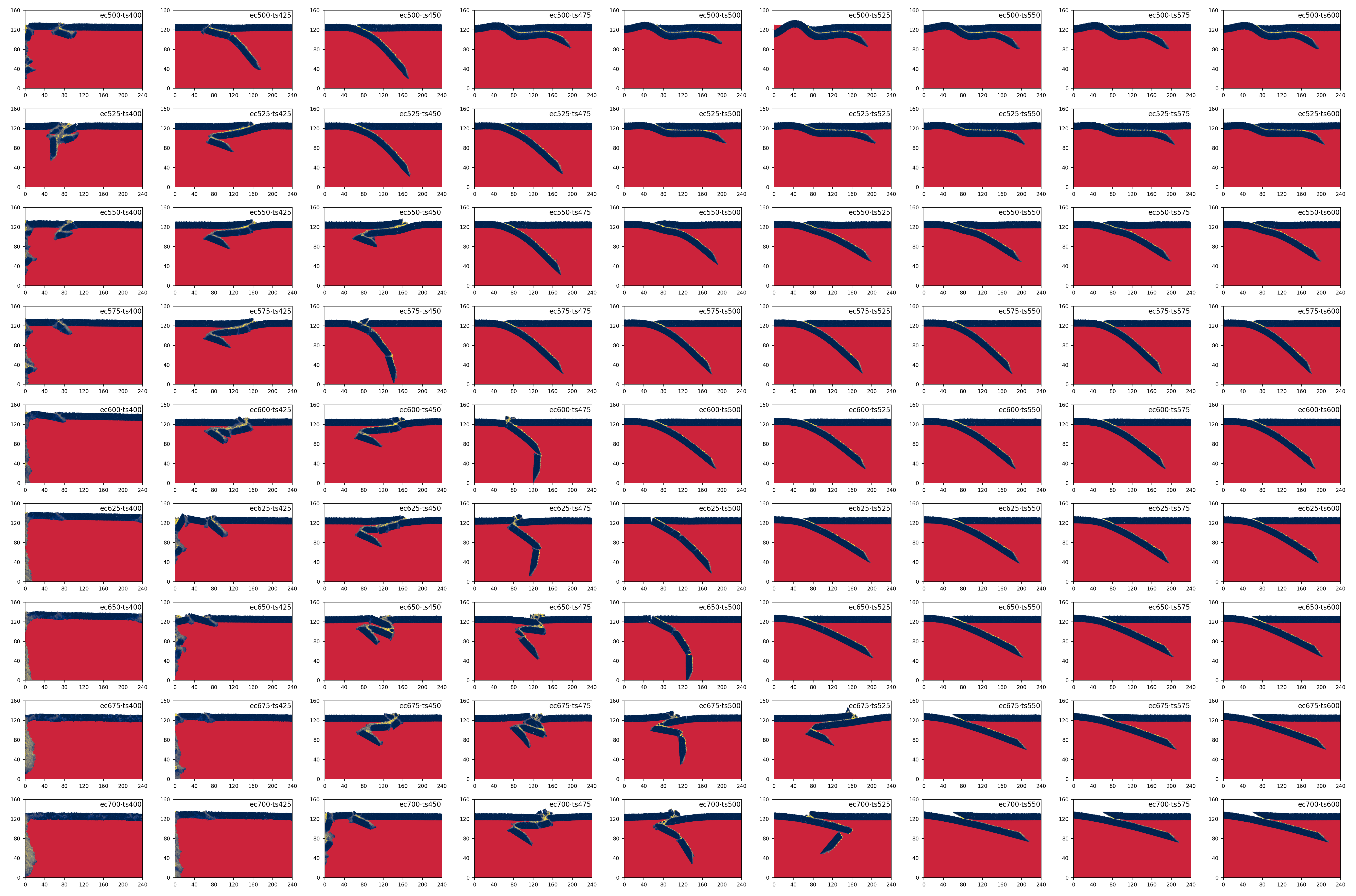
A qsDEM model to simulate subduction will be available soon (depending on the publication of the paper describing it), and definitely by the end of the year. The model (qualitatively) couples DEM with SPH to simulate a brittle lithosphere and a viscous mantle. In slightly more technical terms, the lithosphere is made of bonded DEM grains with enough strength to be compressed laterally (ridge push), a Young's modulus in the range that lets it bend, and enough buoyancy to float on a viscous mantle, which is modeled with particles. The SPH method is based on Morris et al. (1997), and the coupling is inspired by Komoróczi et al. (2013). Its application to subduction, however, is the first of its kind. Below is a parameter sweep of the bonds' Young's modulus and strength (both tensile and shear, although most bonds fail in tension) for a neutrally buoyant crust being compressed.
No LLM was used for writing.